The eighth meeting of the Moscow Format Consultations on Afghanistan, scheduled for 5 October 2026, comes at an important moment for Afghanistan and the wider region. Representatives from Afghanistan, Russia, China, India, Iran, Pakistan, Kazakhstan, Kyrgyzstan, Tajikistan and Uzbekistan are expected to participate. The announced agenda includes political and economic cooperation, counterterrorism, narcotics trafficking and broader regional cooperation.
These are important issues. Yet, nearly five years after the Taliban returned to power, a broader question deserves attention: can the Moscow Format move beyond managing regional relations with Afghanistan and contribute to addressing the unresolved political dimensions of the country’s conflict?
The experience of the past decade suggests that regional engagement is necessary for Afghanistan’s stability. But engagement with one political authority alone cannot substitute for a broader process of conflict resolution. If regional diplomacy is intended to contribute to sustainable peace, it must address not only security and economic cooperation, but also political inclusion, confidence-building and dialogue among Afghanistan’s different political and social stakeholders.
The Moscow Format and a Changing Regional Approach
The Moscow Format emerged at a time when regional perceptions of the conflict in Afghanistan were changing. The consultations began in December 2016 and subsequently developed into a wider regional mechanism. By November 2018, representatives of Afghanistan’s High Peace Council and the Taliban were participating in the consultations, alongside regional countries, while India and the United States attended as observers.
This development took place against a wider geopolitical background. During the early years following 2001, Russia, China and Iran shared important interests with the United States-led international effort in Afghanistan, particularly in counterterrorism and preventing further instability. Over time, however, regional concerns about the direction of the war, the prolonged Western military presence and the possible spillover of terrorism and instability became more pronounced.
The Moscow Format therefore represented more than a Russian diplomatic initiative. It provided a platform through which neighboring states and major regional powers could coordinate their approaches to Afghanistan. Security was central to these discussions, but so was the search for a negotiated political settlement.
This regional dimension mattered because Afghanistan’s conflict had never existed in isolation from its surroundings. A sustainable settlement required not only agreement among the parties to the conflict but also a degree of regional consensus capable of supporting, rather than undermining, a political process.
From Regional Coordination to Political Dialogue
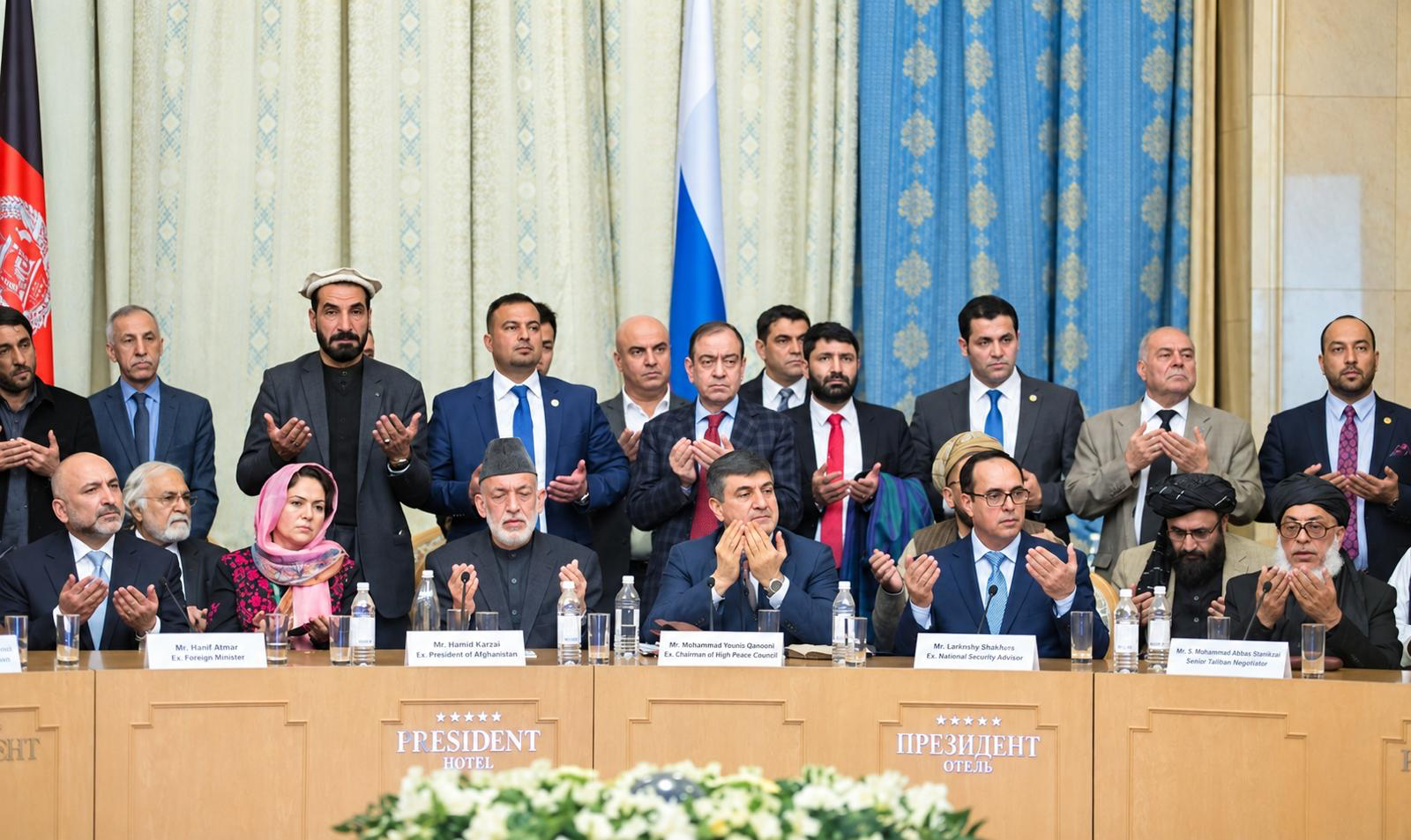
Before 2021, Moscow also provided a venue for dialogue among different political groups. In February 2019, a meeting in Moscow brought Taliban representatives together with former President Hamid Karzai and other political figures. The meeting was organized by an organization representing citizens of Afghanistan living in Russia and was separate from the formal Moscow Format. Although the government of Afghanistan did not officially participate, the gathering illustrated Moscow’s potential to facilitate dialogue among different political groups.
The formal Moscow Format had shown similar potential a few months earlier. At its November 2018 meeting, representatives of the High Peace Council and the Taliban participated in the same regional consultations.
These initiatives did not produce a political settlement, but they were part of a broader shift toward accepting dialogue as necessary to end the conflict. Their significance was not that Moscow succeeded in bringing peace to Afghanistan—it did not—but that regional diplomacy increasingly recognized that competing political actors had to be brought into a negotiating process.
In that sense, the Moscow Format had a useful function: it combined regional coordination with the possibility of confidence-building around an eventual political settlement.
The Regional Opportunity After 2021
The withdrawal of United States and NATO forces and the collapse of the previous Afghan government in August 2021 fundamentally changed the geopolitical environment.
For years, some regional powers had viewed the foreign military presence as an obstacle to the development of a more independent regional approach to Afghanistan. Once that presence ended, Russia, China, Iran, Pakistan, India and the Central Asian states had considerably greater space to shape regional diplomacy.
Five years later, however, the limits of that opportunity are increasingly visible.
Regional states have maintained or expanded relations with the Taliban authorities, but this engagement has not developed into a coherent political mechanism for addressing Afghanistan’s unresolved internal questions. Regional interests overlap in important areas—terrorism, narcotics, border security, trade, connectivity and stability—but individual countries continue to approach Afghanistan largely through their own national priorities.
The evolution of the Moscow Format reflects this change. Recent meetings have placed growing emphasis on security, counterterrorism, trade, investment and economic cooperation. Yet political concerns have not disappeared. In its 2024 Joint Statement, participants expressed concern over terrorist groups based in Afghanistan, called for stronger counterterrorism cooperation and noted the potential for expanding economic and trade relations. The statement also called on the de facto authorities to create conditions for a political system in which major ethno-political groups could participate.
Another important shift occurred in 2025. Afghanistan participated in the Moscow Format as a formal member for the first time, represented by the Taliban authorities. This marked an important stage in the evolution of the mechanism. A platform that had previously been closely associated with regional discussions of peace and reconciliation was increasingly becoming a structured forum for regional engagement with the authorities in Kabul.
The question now is whether engagement alone is enough.
Beyond the Absence of War
Afghanistan today is not experiencing the same nationwide insurgency and international military conflict that characterized the years before August 2021. That change is significant and should be acknowledged. But the decline of large-scale warfare should not automatically be equated with the resolution of the underlying conflict.
Peacebuilding scholarship distinguishes between the absence of direct violence—often described as negative peace—and the political and social conditions necessary for positive and sustainable peace. This distinction remains highly relevant to Afghanistan.
Questions surrounding political participation, governance, rights, representation and the future political order have not been resolved. The absence of the previous form of war has not removed disagreements over how the country should be governed or who should participate in determining its political future.
These concerns are reflected in the positions of regional states themselves. Moscow Format participants have called for broader political participation while simultaneously emphasizing security and economic cooperation. The 2024 joint statement, for example, called on the de facto authorities to establish an inclusive system of governance that would reflect the interests of different segments of Afghanistan’s population.
Regional security concerns have also persisted. Terrorism and the presence of militant organizations in Afghanistan remain prominent concerns in regional diplomacy. Counterterrorism is again among the central issues announced for the October 2026 meeting.
The lesson is that stability cannot be measured only by whether the previous war has ended. Sustainable peace requires mechanisms capable of addressing the political and social disputes that continue to shape Afghanistan’s future.
The Missing Political Dimension
This is where the current Moscow Format faces one of its most important limitations.
If its main purpose is to coordinate economic relations, counterterrorism policies and diplomatic engagement between regional governments and the authorities in Kabul, its current structure can serve that purpose.
But contributing to sustainable peace requires something more.
The publicly announced participants in the October 2026 meeting include the Taliban-led delegation and representatives of regional states. The announced participant list does not include representatives of civil society, women’s organizations or non-Taliban political actors.
A political process does not require every organization to receive equal status, nor should outside powers determine Afghanistan’s political future. But meaningful conflict resolution requires channels through which the principal political and social constituencies can address competing views about the state, governance and the country’s future.
This is where the earlier logic of confidence-building deserves renewed attention. Regional diplomacy could create opportunities for the Taliban authorities, political figures, civil society representatives, women and other relevant stakeholders to communicate about areas of disagreement and possible convergence.
Such dialogue does not need to begin with a grand political conference. It can develop gradually through consultations, expert discussions, confidence-building meetings and structured political dialogue.
Without this dimension, regional conferences risk becoming more effective at managing the consequences of Afghanistan’s unresolved conflict than at helping address its causes.
Russia’s Potential Role
Russia remains an influential regional actor. It has longstanding historical relations with Afghanistan, strong ties across Central Asia and important relationships with China, Iran, India and Pakistan. Moscow also maintains extensive relations with the Taliban authorities. These connections give Russia considerable convening capacity.
That capacity could be used more broadly.
Facilitating a wider political process would not require Russia to position itself against the Taliban, nor should regional diplomacy attempt to impose a particular political model on Afghanistan. Moscow could instead use its relations with the authorities in Kabul and its regional partners to encourage structured dialogue involving a wider range of political and social stakeholders.
This could begin with consultations involving civil society and women’s representatives, engagement with non-Taliban political actors committed to peaceful dialogue, and expert discussions on governance, security and regional cooperation. Over time, such contacts could provide opportunities for confidence-building among competing political stakeholders.
Engagement with the Taliban and dialogue with other political and social constituencies are not mutually exclusive. In fact, maintaining channels with a broader range of actors could strengthen the credibility of Russia and of the Moscow Format as a facilitator.
The wider region also has a role to play. No single neighboring or regional power is likely to resolve Afghanistan’s political challenges independently. What has been missing since 2021 is not regional interest in Afghanistan, but a sufficiently coherent regional mechanism that connects security and economic engagement with political peacebuilding.
Conclusion
The Moscow Format remains one of the most established regional mechanisms focused on Afghanistan. Its continued existence reflects a basic reality: developments inside Afghanistan have direct consequences for neighboring states and the wider region.
The next step, however, requires a clearer understanding of the difference between regional engagement and regional peacebuilding.
Trade, connectivity, diplomatic communication and counterterrorism cooperation all matter. But sustainable peace also requires attention to the roots of conflict, political participation, confidence-building and peaceful ways of addressing competing political and social visions.
Afghanistan’s recent history offers an important lesson. Military intervention did not produce a sustainable political settlement, but diplomatic engagement with a single political actor is also unlikely, on its own, to resolve a multidimensional conflict. A durable settlement ultimately requires meaningful participation by the country’s relevant political and social stakeholders, while regional states can help create an environment in which dialogue becomes possible.
The Moscow Format therefore still has room to evolve. It can remain a mechanism for regional states to coordinate their relations with the authorities in Kabul while gradually developing a second and equally important function: facilitating political dialogue and supporting a broader regional approach to sustainable peace.
For Russia, China and Afghanistan’s neighboring states, this does not require abandoning their current engagement. It requires broadening its purpose.
If regional powers seek a stable Afghanistan that does not again become a source of insecurity, displacement, extremism or interstate tension, regional diplomacy will have to address not only Afghanistan’s relations with its neighbors, but also the unresolved political foundations of peace within the country. That is where the Moscow Format’s most important unrealized potential may lie.