
Introduction
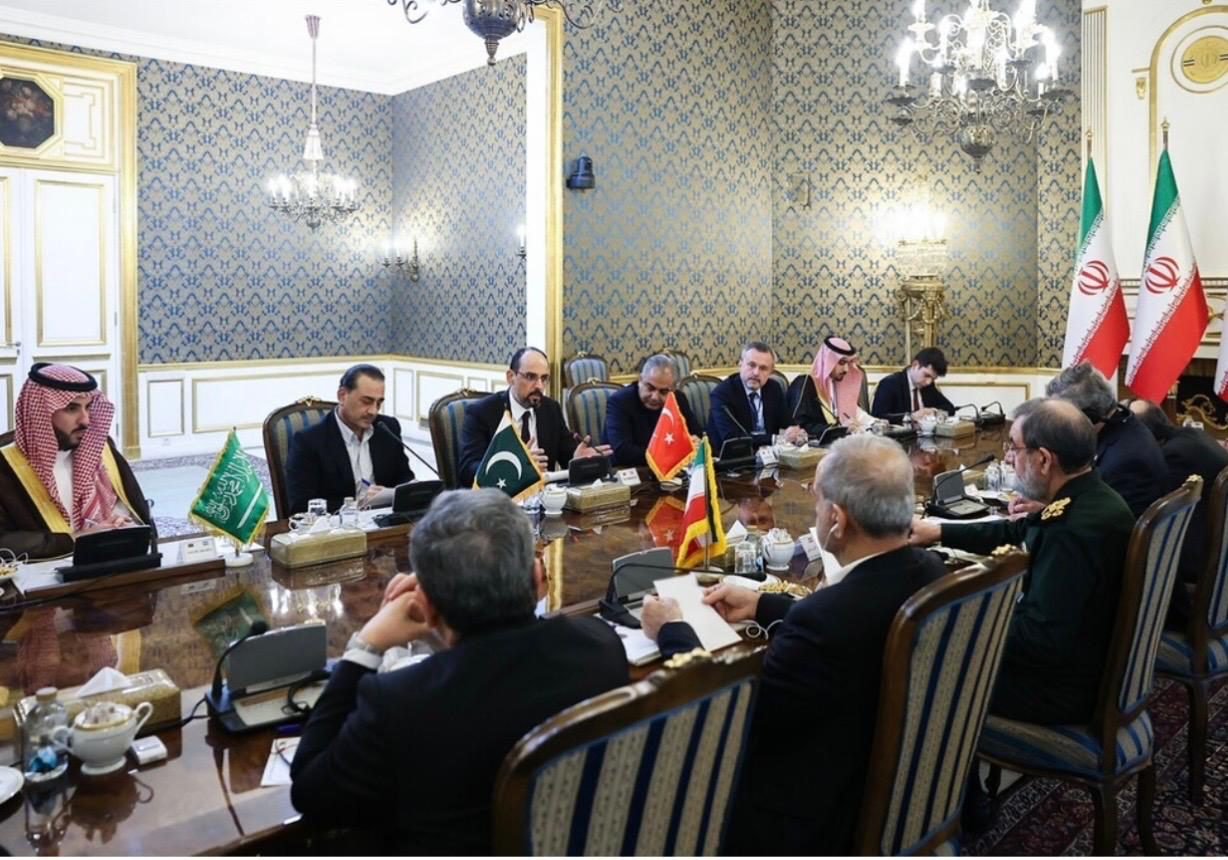
The quadrilateral meeting in Tehran took place amid a conflict that began with United States and Israeli strikes against Iran and subsequently affected the Persian Gulf, Yemen and regional maritime security. Senior Iranian officials met Saudi Defence Minister Prince Khalid bin Salman, Pakistan’s army chief Field Marshal Asim Munir and Türkiye’s intelligence chief Ibrahim Kalın. All three visiting countries belong to the Mecca Joint Defence Agreement, signed in August 2026. The importance of this encounter lies precisely in that combination: a new defence arrangement intended to strengthen deterrence was engaging directly with Iran rather than treating diplomacy and defence as mutually exclusive.
According to the joint statement issued after the talks, the four governments agreed to continue consultations on cooperation, peace and regional security. No detailed, enforceable settlement over Yemen or the wider Iran–US confrontation was announced. The central analytical question is therefore not whether Tehran resolved the crisis, but whether the meeting represents an early attempt to reconcile competing security interests through sustained diplomacy.
A regional crisis with interconnected fronts
The present crisis cannot be understood solely as a confrontation between Iran, the United States and Israel. Its consequences extend to attacks on Saudi territory, the war in Yemen, disruptions to the Strait of Hormuz, threats to the Red Sea corridor and heightened economic uncertainty. Escalation in one theatre can alter threat perceptions and strategic choices in another. This interconnectedness has increased the potential costs of miscalculation for governments that are not direct parties to every military confrontation.
For Saudi Arabia, the principal concern is the security of its territory, energy infrastructure and long-term economic development. For Iran, priority questions include military threats, sanctions, maritime restrictions and the conditions under which diplomatic negotiations might resume. Türkiye and Pakistan have their own calculations: both seek to preserve their strategic relations with Riyadh while maintaining functioning channels with Tehran. Their interests are not identical, yet each has reason to prevent another regional war.
The Tehran meeting can thus be interpreted as an instance of pragmatic security diplomacy. Shared concern about instability does not erase strategic rivalry; it may, however, generate a limited common interest in de-escalation. Such common interests are often the starting point for confidence-building measures, even before deeper political disagreements have been addressed.
Saudi Arabia, the Mecca Pact and the limits of external security guarantees
Saudi Arabia’s participation is especially significant. Riyadh has long maintained close security ties with Washington, but the recent confrontation with Yemen’s Houthis has demonstrated the distinction between a security partnership and a commitment to undertake every requested military operation. In September, Reuters reported that Washington declined Saudi requests for direct US strikes on the Houthis at that stage, while offering intelligence sharing and targeting support. It would therefore be inaccurate to say that the United States provided no support; the strategic issue is the limits of direct intervention.
This distinction may encourage Riyadh to diversify its crisis-management options. Deterrence remains important, but direct engagement with Iran offers another instrument for reducing risks to Saudi security. The Mecca Joint Defence Agreement strengthens collective defence among Saudi Arabia, Türkiye and Pakistan and treats an armed attack against one member as an attack against all. At the same time, the pact creates a difficult strategic calculation: measures intended to reassure members could, if accompanied by continued military escalation, draw additional regional actors into a broader confrontation.
Tehran therefore reveals an important tension between deterrence and dialogue. The two are not necessarily contradictory. A credible defence posture may coexist with negotiations designed to lower the likelihood that collective defence obligations will be tested. This balance, rather than a sudden strategic realignment, is a more persuasive way to interpret Saudi participation.
Some political interpretations suggest that a direct Iran–Saudi confrontation could benefit external actors by increasing regional fragmentation and dependence on outside security providers. That is a proposition about possible consequences, however, not evidence of a verified US plan to engineer such a war. A sound assessment must distinguish strategic incentives and speculation from demonstrated policy intentions.
The diplomatic roles of Pakistan and Türkiye
Pakistan and Türkiye are positioned to facilitate communication because each maintains relations with the principal parties. Pakistan combines longstanding defence ties with Saudi Arabia, geographic proximity to Iran and contacts with Washington. Reporting on the Tehran talks indicates that the meeting was proposed during Asim Munir’s visit to Iran the preceding week, underscoring Islamabad’s practical role as a diplomatic intermediary. Pakistan and Qatar have also been active in efforts to reopen channels between Tehran and Washington.
Türkiye brings a different set of assets: a substantial regional diplomatic presence, defence cooperation with Riyadh and an interest in avoiding renewed conflict on its wider periphery. Ankara may help sustain communication between the participants, even when it cannot bridge all substantive differences. The available evidence does not establish that the Tehran meeting was designed at a separate gathering in Istanbul; that claim should not be presented as fact without further documentation.
The broader opportunity is to move from ad hoc mediation to a more predictable consultation mechanism. Regular security dialogue, crisis hotlines, reciprocal assurances and narrowly defined confidence-building measures could help prevent incidents from producing uncontrolled escalation. Yet mediation only succeeds when the principal parties are prepared to make meaningful commitments, not merely to exchange messages.
Yemen and the test of Iran–Saudi de-escalation
Yemen is likely to be the most immediate test of whether the Tehran initiative can produce practical results. Intensified Houthi attacks against Saudi targets, together with Saudi-backed military operations inside Yemen, have increased the danger of a wider war and added pressure on civilian infrastructure. The consequences are both regional and humanitarian: further escalation could threaten transport routes and deepen the suffering of communities already affected by prolonged conflict.
Iran’s relations with the Houthis give Tehran potential influence in encouraging restraint. Influence, however, is not equivalent to complete operational control. Analyses of the Iran–Houthi relationship stress that the movement has its own political and military priorities in Yemen. Diplomatic expectations should therefore be realistic: Tehran could facilitate de-escalation, but a sustainable outcome would also require decisions by the Houthis, Saudi Arabia and other Yemeni parties.
Two contrasting pathways are possible. If Iranian engagement helps discourage further cross-border attacks while Saudi Arabia supports reciprocal restraint, the meeting could create conditions for modest confidence-building. Conversely, continued attacks followed by an expanded collective military response could reinforce threat perceptions, harden positions and increase the risk of regional spillover.
Reducing cross-border hostilities would still not amount to peace in Yemen. A durable political settlement would require an inclusive Yemeni process, civilian protection, humanitarian access and workable arrangements for governance and security. Independent analysis of Yemen’s evolving conflict illustrates why regional understandings must be linked to the country’s internal political dynamics.
Washington, Israel and the limits of regional diplomacy
The prospects for de-escalation will also depend on decisions taken beyond the four participating governments. The risk of renewed US or Israeli military action against Iran could undermine regional assurances even if Tehran and Riyadh agree on short-term restraint. The nuclear dispute, sanctions, maritime restrictions and competing demands over sequencing remain major obstacles to negotiations between Iran and Washington.
Domestic electoral considerations may shape the diplomatic environment. Israel is scheduled to hold its parliamentary election on 27 October 2026, followed by the US midterm elections on 3 November. A change in Israel’s governing coalition could alter the political space for diplomacy, but it would not automatically transform Israel’s security concerns or its policy toward Iran. Equally, the US election may affect domestic political incentives without determining the outcome of subsequent negotiations.
The four countries’ engagement could nevertheless convey an important message: regional actors have direct interests in preventing the resumption of large-scale hostilities and should not be treated merely as spectators. Their ability to influence Washington or Tehran will remain limited unless regional efforts are accompanied by credible proposals addressing the underlying disputes.
Three possible scenarios
Scenario one: Gradual de-escalation. Iran and Saudi Arabia take reciprocal steps to contain cross-border attacks, while Pakistan, Türkiye and Qatar help maintain diplomatic channels. Incremental confidence-building could make a regional non-aggression understanding more plausible, although a comprehensive settlement would remain distant.
Scenario two: Dialogue without a breakthrough. The parties preserve channels of communication but fail to resolve competing security demands. Tehran would then represent a mechanism for crisis management rather than a turning point in regional security cooperation. This may still be valuable if it reduces the danger of miscalculation.
Scenario three: Diplomatic breakdown and renewed escalation. Further Houthi strikes, a larger military response or renewed US–Israeli attacks on Iran could overwhelm existing channels and widen the conflict. Under such conditions, defence commitments and reciprocal threats might accelerate escalation rather than contain it.
Conclusion
The Tehran quadrilateral meeting is a potentially significant diplomatic development, but it should not yet be described as the emergence of a new regional security order. Its immediate achievement is narrower: three members of the Mecca defence arrangement chose to engage Iran directly at a time when military confrontation is a serious risk. This suggests that regional governments are exploring how deterrence and dialogue might be combined rather than choosing one at the expense of the other.
The measure of success will be practical rather than rhetorical: fewer attacks, functioning communication channels, reciprocal restraint and a credible path toward negotiations on the wider conflict. If sustained, the process could demonstrate the value of regional diplomatic agency and cooperation among Muslim-majority states. If it fails, the costs of escalation will fall heavily on the same societies whose security the participants seek to protect.
Ultimately, Tehran raises a strategic question that extends beyond the meeting itself: can the region’s states develop sufficient diplomatic capacity and mutual confidence to manage their security challenges collectively, or will their future remain dominated by military escalation and competition among external powers? The answer will depend less on declarations than on the decisions taken in the weeks and months ahead.