
Introduction
Afghanistan’s conflict has domestic and regional dimensions. Within the country, disagreements concern political authority, representation, rights, and the relationship between the state and society. Beyond its borders, neighbouring states and regional powers influence Afghanistan through diplomacy, security policies, economic relations, and connections with Afghan actors. Regional peacebuilding must address both dimensions. Cooperation among governments can reduce tensions, but lasting peace also requires a process through which Afghans can negotiate their differences and develop legitimate national institutions.
Regional discussions often emphasize trade, transport, energy, and counterterrorism. These activities can support livelihoods and reduce shared risks. Their contribution to peace, however, depends on whether they help address the political causes of conflict. Transport connections cannot determine how authority should be exercised, and border agreements cannot provide citizens with representation. This article therefore asks: How can regional states support an Afghan-led process of conflict resolution and help build a legitimate political order that sustains peace? It argues that regional diplomacy should support political dialogue and accountable institutions, while economic cooperation builds confidence and consolidates progress.
Understanding Regional Peacebuilding
Regional peacebuilding refers here to cooperation among states and societies to address the causes of conflict, support peaceful political arrangements, and prevent renewed violence. It is an analytical framework drawing on established peace and conflict concepts. Johan Galtung’s distinction between negative and positive peace provides a starting point. Negative peace concerns the absence of direct violence. Positive peace addresses structural violence: social and institutional arrangements that systematically prevent people from meeting their needs and developing their capabilities (Galtung, 1969). Reduced fighting is therefore valuable, but it does not by itself demonstrate that the foundations of lasting peace exist.
Conflict resolution seeks to address the incompatibilities underlying a conflict and develop arrangements acceptable to the parties. Conflict transformation also examines the relationships, institutions, and inequalities that sustain destructive conflict. Lederach’s approach connects responses to immediate crises with longer-term social change (Lederach, 2003). Peacebuilding supports the conditions in which peaceful arrangements can endure.
Applied to Afghanistan, these concepts suggest that negotiation must be accompanied by changes in political participation, public accountability, and relationships between communities. Peace does not require the disappearance of disagreement; it requires ways to manage disagreement without coercion or violence.
The regional dimension concerns how external relationships support or obstruct these changes. Research on Afghanistan’s neighbourhood shows that surrounding states operate within different security environments and may pursue competing interests (Harpviken, 2010). Shared concerns consequently do not guarantee cooperation. A regional approach must examine these tensions and identify practical commitments that reduce interference. Its guiding proposition is that domestic and regional peace can reinforce each other: legitimate institutions can make regional agreements more durable, while coordinated external restraint can give Afghans greater space to negotiate. This relationship is a possibility to be cultivated rather than an automatic outcome.
Afghanistan’s Political Conflict
The end of the nationwide war between the Taliban and the former republic in 2021 changed Afghanistan’s pattern of conflict. Reduced battlefield confrontation offered relief to communities affected by prolonged warfare. Nevertheless, the end of that war should not be equated with complete negative peace. The Secretary-General’s September 2025 report documented armed opposition incidents, cross-border violence, and human rights violations, alongside restrictions on women’s participation in civic life (United Nations, 2025, paras. 16–19 and 26–36). These findings show why an assessment of peace must consider direct violence, coercion, and exclusion together.
The unresolved political questions concern who governs, how leaders are selected, how authority is limited, and how citizens influence decisions. Military control cannot create broad agreement on these questions. Positive peace requires institutions that protect rights, provide access to justice, and allow peaceful political opposition. A legitimate national government would be an important foundation, but legitimacy requires more than selecting officials from different communities. Participation must affect decisions, public authority must be accountable, and people must have credible ways to challenge abuses. A political settlement that leaves these relationships unchanged may preserve order without resolving the sources of conflict.
Domestic legitimacy also differs from international recognition. Recognition concerns relations between states; domestic legitimacy concerns the basis on which people accept political authority. Regional governments can facilitate dialogue and support agreed reforms, but they cannot confer public acceptance on behalf of Afghans. The proposed approach therefore seeks an Afghan-owned political settlement, rather than an externally designed government. Its institutional form should emerge through negotiation, with meaningful participation by women and men from different social and political backgrounds. Protecting participants and enabling independent views would be essential to making that process credible.
Central Asia’s Role
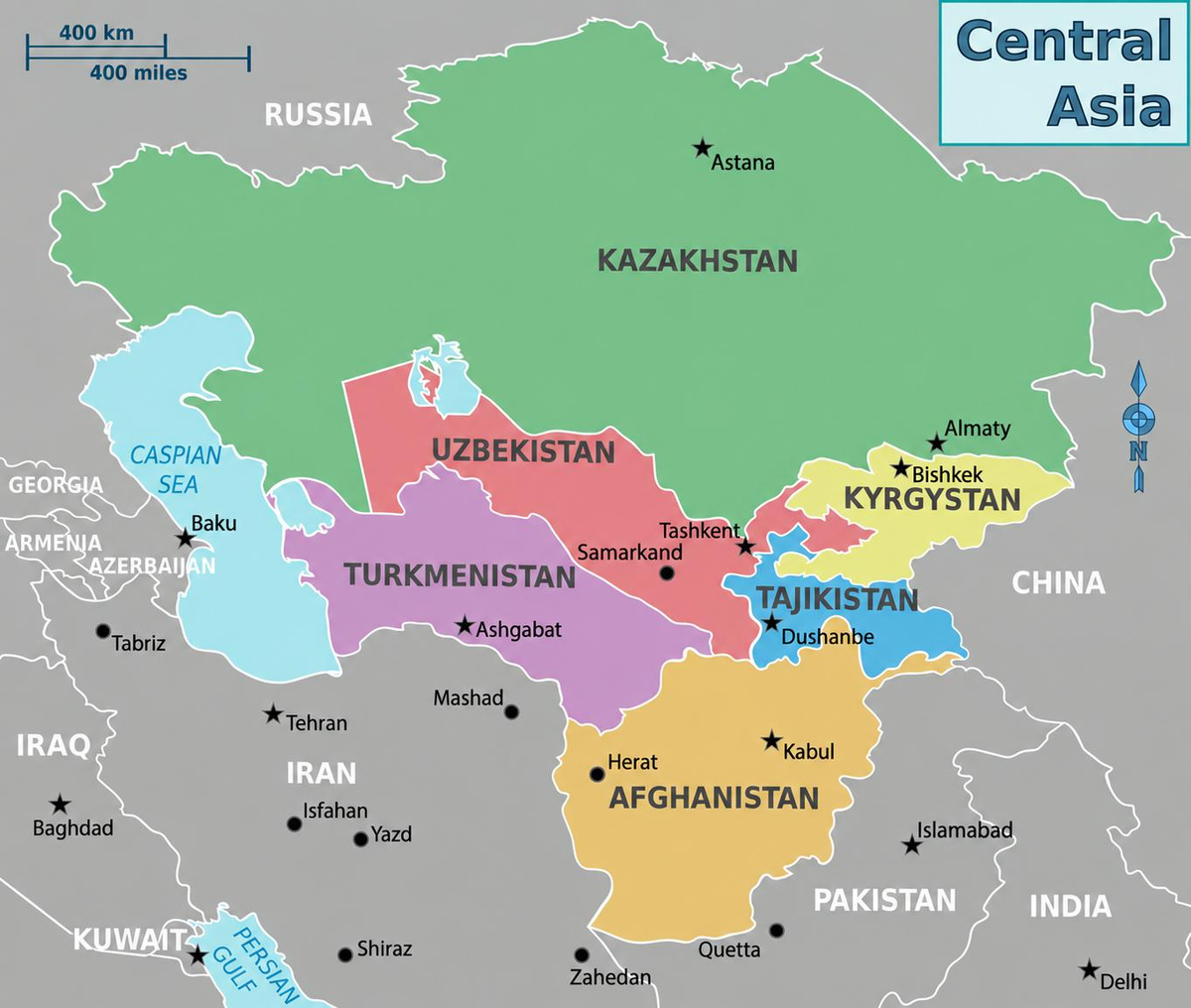
Uzbekistan, Tajikistan, Turkmenistan, Kazakhstan, and Kyrgyzstan can contribute through their geographical position and relationships with Afghanistan. However, they should not be treated as a single actor. Their border exposure, economic interests, and perceptions of security differ. Tadjbakhsh’s study of Central Asia highlights the limits of assuming that common concerns about Afghanistan will produce a unified regional response (Tadjbakhsh, 2012). Although written before the Taliban’s return to power, this research offers a useful conceptual warning: a mechanism must accommodate differences among participating states rather than build on an assumed consensus.
Existing engagement provides potential channels for dialogue. The September 2025 UN report recorded Uzbek participation in discussions on connectivity and energy, a Kazakh ministerial visit concerning trade and railway cooperation, and an agreement to study a trans-Afghan railway (United Nations, 2025, paras. 22–23). These contacts establish opportunities for communication; they do not demonstrate agreement on an inclusive political settlement. The peacebuilding question is whether practical engagement can create space for wider Afghan participation and political discussion. Economic contact becomes more relevant to conflict resolution when it helps build relationships beyond official negotiations over commercial projects.
Central Asian states could offer venues for exploratory discussions among Taliban representatives, political groups, women’s organizations, civil society, and other Afghan participants. Uzbekistan and Kazakhstan could draw on diplomatic and research networks; Tajikistan and Turkmenistan could contribute perspectives shaped by their direct borders; Kyrgyzstan could support academic exchange and regional dialogue. These are possible contributions, not claims of agreed commitments. Research institutions could facilitate informal dialogue, sometimes called Track II diplomacy, to explore concerns before formal negotiations. Credibility would depend on fair selection, transparent procedures, and protection against pressure. No venue should be assumed neutral simply because it hosts a meeting.
The Wider Regional Context
Central Asian initiatives operate within a wider environment involving Pakistan, Iran, China, India, and Russia. Their different relationships with Afghanistan make coordination difficult but important. Earlier research on South Asia demonstrates how India–Pakistan rivalry has shaped engagement with Afghanistan (Tadjbakhsh, 2011). This historical perspective helps explain why cooperation must address relationships among external actors as well as their bilateral ties with Afghan authorities. A framework that overlooks regional competition may convene meetings while leaving the pressures sustaining conflict intact.
Each state could contribute to a peaceful regional approach to Afghanistan’s political conflict. Pakistan, Iran, China, India, and Russia, alongside the Central Asian states, could support a regional initiative that creates opportunities for dialogue between the Taliban authorities and opposition political groups and parties, with meaningful participation by civil society, women’s representatives, and other Afghan communities. These countries could encourage Afghan participants to negotiate their differences and develop an agreed political framework for a legitimate and representative national government. Afghanistan is a multiethnic society, and its diverse communities need meaningful representation and influence within political institutions. The concentration of power in a single group, including under the present Taliban authorities, can sustain grievances and increase the risk of renewed conflict when other groups lack peaceful channels for participation. Regional efforts should therefore support an Afghan-led dialogue on how political authority can be shared, exercised, and held accountable. The aim would be a broadly accepted political settlement through which Afghanistan’s diverse communities can see themselves represented and address their disagreements peacefully.
A Regional Mechanism for Dialogue
A practical mechanism could link a continuing regional contact group, United Nations facilitation, and an Afghan-led political dialogue. The 2023 UN independent assessment offers a relevant reference point: it proposes coordinated engagement and a political pathway connecting Afghanistan’s international reintegration with governance and rights concerns (United Nations, 2023). The mechanism outlined here is the author’s proposal, rather than an existing agreement. Its feasibility would depend on the willingness of Afghan parties and regional governments to participate, accept safeguards, and implement commitments.
The first step would establish shared principles and coordinate regional policy. Participating states should commit to sovereignty, territorial integrity, civilian protection, non-support for armed proxies, and preventing the use of Afghan territory for attacks abroad. A contact group involving neighbouring countries, Central Asian states, and relevant regional powers could then maintain communication and support negotiations. It should coordinate with existing diplomatic processes to avoid duplication. UN facilitation could provide continuity, while a small secretariat would record commitments, identify policy disagreements, and maintain contact during crises.
The second step would organize meaningful Afghan participation. Taliban authorities, political groups, women’s representatives, civil society, religious scholars, professional associations, victims’ groups, and local communities should have opportunities to shape the agenda. Selection must recognize differences within communities: no organization represents all women, an entire ethnic group, or the whole diaspora. Consultations inside Afghanistan, where participation can occur safely, should complement discussions abroad. Confidential initial meetings, independent facilitation, and safeguards against retaliation could help make dialogue possible. Attendance alone would not constitute inclusion; participants must influence proposals and decisions.
The third step would address the substance of the political conflict. Negotiations should examine leadership selection, limits on authority, public accountability, local participation, fundamental rights, and lawful political opposition. They should also consider justice and the grievances of people harmed by conflict. The objective would be a broadly accepted national political framework, with institutional arrangements determined by Afghans. An immediate comprehensive settlement may be unrealistic. Initial agreements on participation, protections, and procedures could establish a foundation for further negotiations, provided that limited steps do not become substitutes for addressing the central political questions.
The fourth step would connect incentives with implementation. Regional states could offer staged diplomatic and economic benefits in response to measurable, agreed commitments. Humanitarian assistance and essential services should remain protected from political bargaining. Benchmarks should identify responsibilities, timelines, and ways to verify progress, including independent reporting and procedures for addressing violations. Incentives are useful only when regional governments coordinate them and Afghan parties regard the commitments as credible. Regular review would allow adjustments while keeping rights, participation, and peaceful conflict resolution central to the process.
Sustaining Peace through Cooperation
The proposed pathway gives priority to political conflict resolution and legitimate institutions, with regional cooperation helping consolidate peace. This is a sequence of priorities, not a rigid timetable. Essential trade, electricity, education, and humanitarian cooperation should continue during negotiations. Practical cooperation can build confidence by addressing shared needs, while political progress makes larger commitments more credible. The central test is whether activities strengthen relationships and institutions that enable people to manage disputes peacefully. Greater transit traffic or additional government revenue alone would be an insufficient measure of success.
Connectivity projects should therefore involve local consultation, transparent contracts, fair compensation, and accountable distribution of benefits. Security cooperation should include border hotlines and credible investigation of disputed incidents, with safeguards against suppressing peaceful political activity. Refugee arrangements should protect vulnerable people and support voluntary, safe, and dignified return where conditions permit. Water cooperation could use technical dialogue and shared information to prevent disputes from escalating. These proposals connect material cooperation with conflict prevention: each seeks to reduce grievances, improve trust, and create peaceful procedures for resolving differences.
Regional cooperation should also complement wider international engagement. Educational partnerships, development resources, and responsible financial access can support recovery beyond immediate neighbouring markets. Over time, cooperation can become part of conflict transformation when institutions distribute benefits fairly and communities have a voice in decisions. This outcome requires sustained implementation and public accountability. Regional partners should assess progress through people’s security, opportunities, and political participation, while Afghan institutions develop the capacity to maintain peaceful relations at home and reliable commitments abroad.
Conclusion
Regional peacebuilding can contribute to Afghanistan’s future when external engagement supports domestic conflict resolution. Central Asian states can offer diplomatic channels, research partnerships, and venues for dialogue. Their contribution will be stronger when Pakistan, Iran, China, India, and Russia coordinate support and limit competitive interference. The United Nations could facilitate this cooperation, but Afghans must determine the substance of their political settlement. Regional action can create opportunities and reduce obstacles; it cannot replace the political willingness and public participation needed within Afghanistan.
The pathway connects shared regional commitments, meaningful Afghan dialogue, legitimate and accountable national institutions, and equitable cooperation across borders. These stages may overlap, but their political purpose should remain clear. Reduced warfare provides an opening toward peace; positive peace requires rights, justice, public trust, and institutions capable of managing disagreement without coercion. For CARPS, regional peacebuilding should be understood through this connection between conflict resolution, domestic legitimacy, and sustainable cooperation. Its measure is whether Afghans can shape their future peacefully and whether regional relationships help make renewed conflict less likely.